Dr. Ravi Upadhyay- Best Urologist in Varodara
- BAPS Shastriji Maharaj Hospital & Sterling Hospitals Bhayli
SAME DAY APPOINTMENT AVAILABLE

Robotic Prostate Surgery
Our Treatments
- Kidney Stone Treatment
- Prostate Enlargement Treatment
- Robotic Prostate Surgery
- Male Infertility Treatment
- Erectile Dysfunction Treatment
- Urinary Incontinence Treatment
- Uro Oncology Treatment
- Robotic Prostate Surgery in Vadodara
- Urethral Stricture Surgery
- Female Urology Overactive Bladder
- Stapler Circumcision
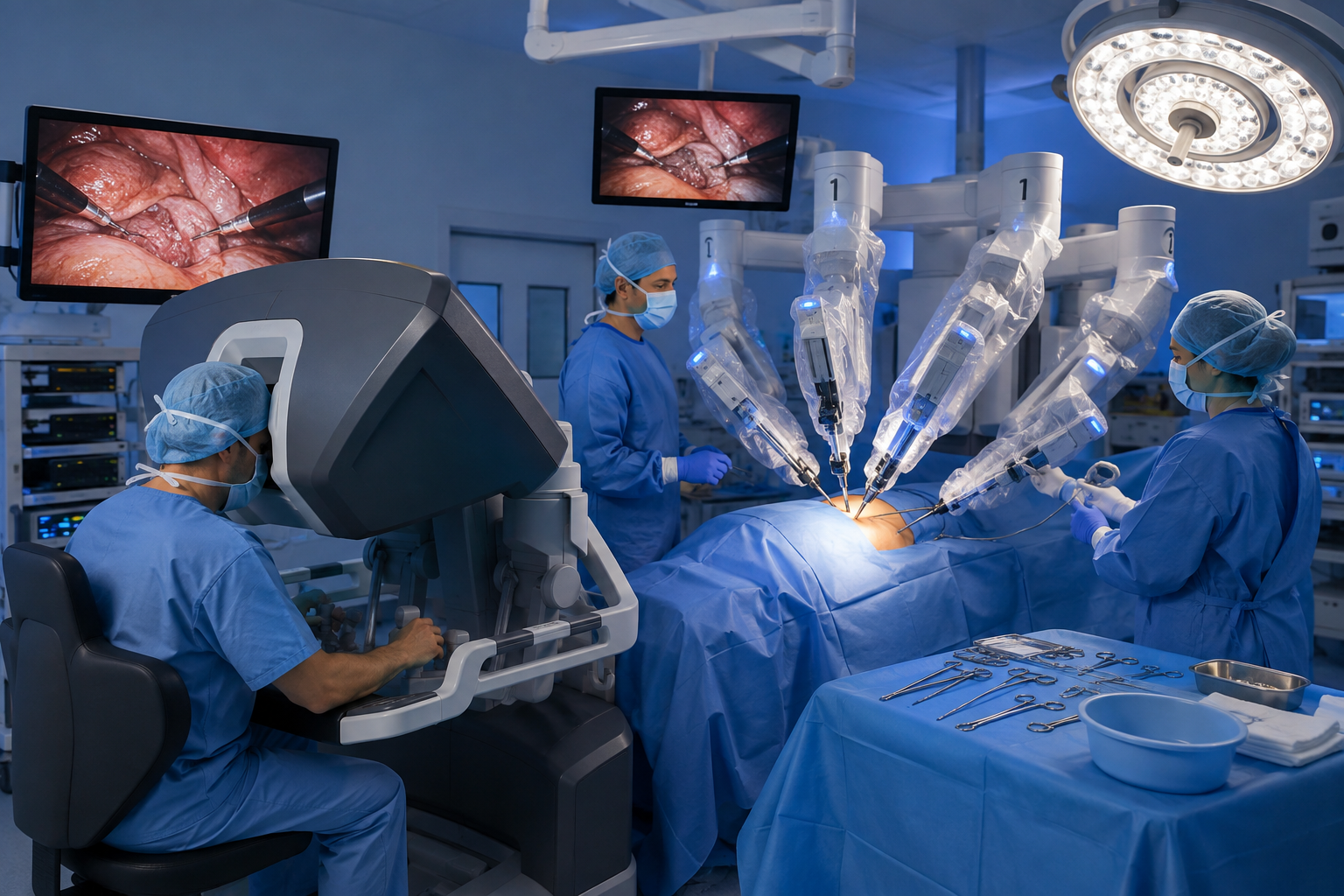
Robotic Prostate Surgery in Vadodara
Robotic prostate surgery in Vadodara is performed by Dr. Ravi Upadhyay using the Da Vinci Robotic Urology system, a technology that allows for significantly greater surgical precision compared to traditional open or laparoscopic prostate surgery. As a Senior Consultant Urologist and Uro Onco Surgeon with more than sixteen years of experience, he uses this approach primarily for complex prostate cancer cases where precision around surrounding nerves and structures directly affects long term urinary and sexual function outcomes.
What Robotic Prostate Surgery Involves
Robotic prostate surgery uses a robotic surgical system controlled entirely by the surgeon to remove the prostate gland through a few small incisions rather than one large open cut. The system translates the surgeon’s hand movements into precise, magnified movements of tiny surgical instruments inside the body, offering a three dimensional, highly detailed view of the surgical area that is difficult to achieve with the naked eye during open surgery.
Unlike what the name might suggest, the robotic system does not operate independently. Every movement is directed by the surgeon in real time, with the robotic arms simply translating those movements with greater precision and stability than the human hand alone.
Why Robotic Surgery Is Recommended for Prostate Cancer
Prostate cancer surgery requires removing the prostate gland while carefully preserving the nerves and structures responsible for bladder control and sexual function, both of which run extremely close to the prostate itself. Traditional open surgery makes this delicate preservation more difficult due to limited visibility and less precise instrument control.
- Magnified, high definition view allows better identification of nerves during dissection
- Smaller, more controlled instrument movements reduce accidental tissue damage
- Reduced blood loss compared to open surgery in most cases
- Smaller incisions lead to less scarring and lower infection risk
- Shorter hospital stay for most patients compared to open prostatectomy
Conditions Treated With Robotic Prostate Surgery
- Localized prostate cancer, where the tumor remains confined within the prostate gland
- Select cases of significantly enlarged prostate, where precision offers a clear surgical advantage over conventional methods
- Complex anatomical cases, where prior surgery or pelvic anatomy makes traditional access more difficult
Not every prostate condition requires or benefits from a robotic approach, and Dr. Upadhyay evaluates each case individually rather than defaulting to robotic surgery for every patient who asks about it.
Before the Procedure
Patients typically undergo a PSA blood test, MRI or ultrasound imaging, and in confirmed cancer cases, a biopsy to determine the extent and grade of the disease before surgery is planned. This staging process helps determine whether robotic surgery is the appropriate treatment path, or whether the case would be better managed through another approach such as radiation therapy or active surveillance for very early, slow growing cases.
During the Procedure
The surgery is performed under general anesthesia and typically takes between two and four hours depending on case complexity. A few small incisions, usually five to six, are made in the abdomen through which the robotic instruments and a camera are inserted. The prostate gland is then carefully separated from surrounding tissue and removed, with nearby lymph nodes sometimes removed as well depending on cancer staging.
Recovery After Robotic Prostate Surgery
Most patients stay in hospital for two to three days following robotic prostate surgery, considerably shorter than the typical stay after open surgery. A urinary catheter is usually required for one to two weeks after the procedure to allow the surgical site to heal properly, after which it is removed and normal urination gradually resumes.
- Hospital stay of two to three days for most patients
- Catheter required for approximately one to two weeks post surgery
- Light activity can typically resume within one to two weeks
- Full recovery and return to normal activity generally takes four to six weeks
- Follow up PSA testing scheduled at regular intervals to monitor recovery
Some temporary urinary leakage and changes in sexual function are common in the weeks following surgery, and these typically improve gradually over the following months as nerves and tissue heal, particularly when nerve sparing techniques were used during the procedure.
Robotic Surgery Compared to Open Prostatectomy
Factor | Robotic Surgery | Open Surgery |
Incision size | Several small incisions | One larger incision |
Blood loss | Generally lower | Generally higher |
Hospital stay | Typically 2 to 3 days | Typically 5 to 7 days |
Recovery time | Around 4 to 6 weeks | Around 6 to 8 weeks |
Precision around nerves | High, magnified 3D view | Limited by direct visibility |